.png)


.svg)
Picking the company that runs your fundraiser is a big decision, and it tends to land on someone who already has plenty on their plate. Three proposals, a board meeting on Thursday, and a stack of glossy brochures that all sound pretty good. We know that's a lot to sort through in a week.
The encouraging part is that this market is much smaller than it looks. Nearly every company you'll come across fits into one of five types, and each type behaves in a predictable way. Once you can tell them apart, your shortlist mostly writes itself.

The five types in one screen
- Product and catalog companies sell goods your families buy, with your school taking a share.
- Managed event companies bring a team to your campus and run a pledge-based event for you.
- Self-run pledge platforms give you the software and leave the running of it to your volunteers.
- Read-a-thon companies build the whole thing around reading, with pledges and no inventory.
- In-house appeals use no company at all, just your school asking its own community.
- The right one depends on your volunteer bench more than on anything printed in the brochure.
- Ask every company for the same number on the same basis and the quotes become comparable.
Product and catalog companies
The classic. Cookie dough, gift wrap, popcorn, discount cards, candles. Families buy something they'd enjoy anyway, and your school keeps a share of what's sold.
Companies here include Charleston Wrap, Believe Kids and distributors like JustFundraising, which sells the Otis Spunkmeyer cookie dough program. Profit shares vary by product and by volume. JustFundraising publishes 40% profit on its cookie dough program, with free shipping once you pass 400 units.
What it asks of you. Quite a lot, and this is the part worth planning for. Your volunteers hand out order forms, chase the money, take delivery of a pallet, sort it by student, and hand out hundreds of individual orders on a single afternoon. If something arrives melted or missing, that's your team's afternoon too.
Who it suits. Schools with a big, enthusiastic volunteer base and a community that genuinely enjoys the product. When you've got the hands, these can do well.
One thing that surprises a lot of boards: a brand like Otis Spunkmeyer isn't the company you sign with. Independent distributors sell the same branded product, and each sets its own profit tiers. If two quotes for the same cookie dough look different, that's why.
Managed event companies
These companies bring a team to your school and run a pledge-based activity event. A fun run, a color run, a glow run, an obstacle course. Families pledge online, and there's no product anywhere in the process.
Apex Leadership Co. is in this group, along with Boosterthon and Get Movin'. They work differently from each other. Boosterthon publishes that its events typically run about nine days, with service levels from a self-serve platform up to a team that handles everything on campus. Get Movin' runs virtually, with what it calls a Personal Event Coach and a free planning call. Apex runs a two-week program with our own team on your campus for all of it.
Where we put our energy. Running the event for you is the starting point. The part we chase hardest is making it the best two weeks of your students' year, because excitement is what turns a program into real money.
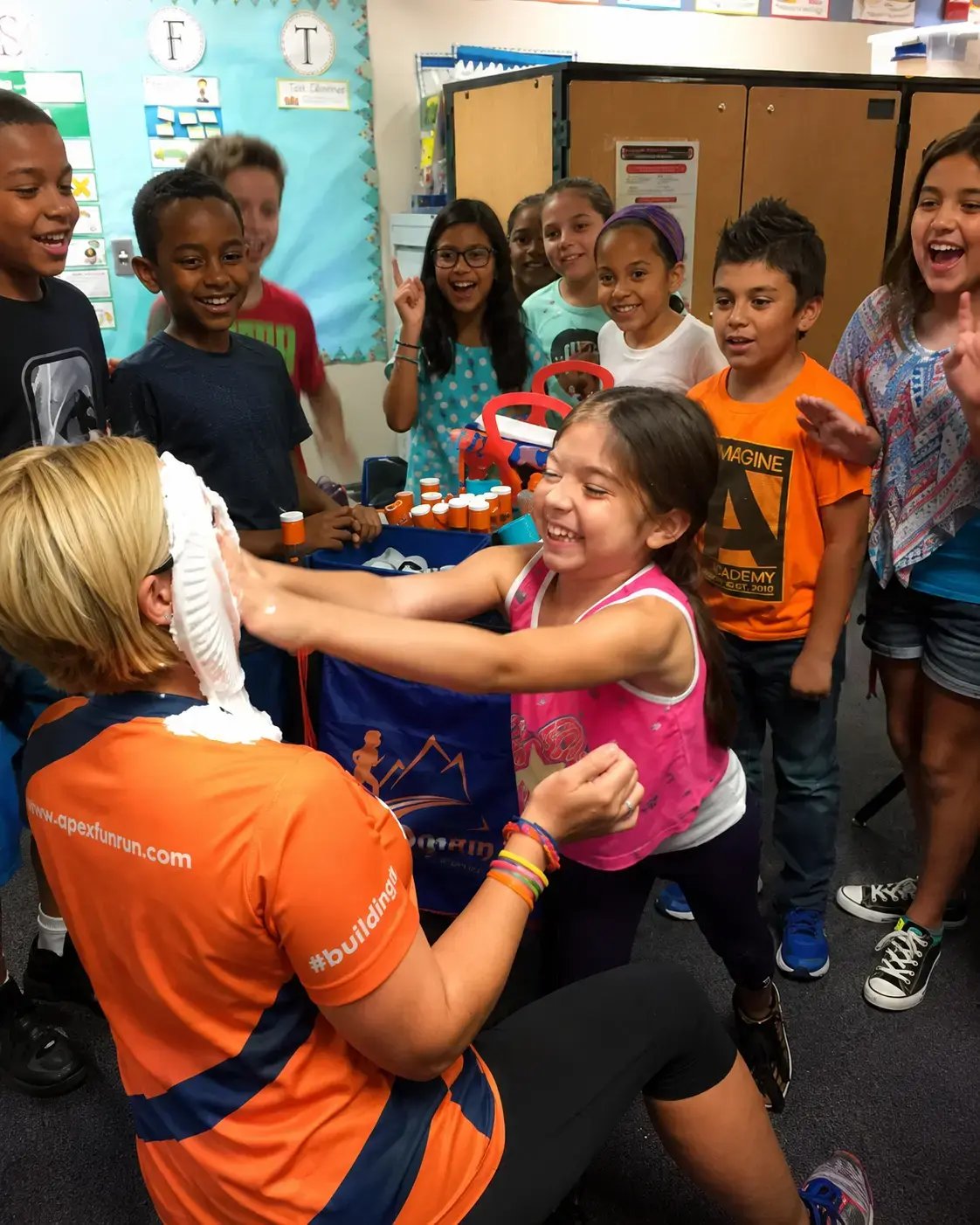
Our athletes are on your blacktop every single morning building that energy. The daily leadership lessons, the class competitions, the countdown to event day, the noise at pickup. Kids go home genuinely fired up and share their own pledge pages, and the giving follows from there. On our own comparison, Apex programs net two to three times what traditional product fundraisers bring in, and that excitement is the whole reason why.
You feel it around the building, too. Teachers stay supported the whole way through, your principal gets a campus that's buzzing for two weeks, and your volunteers get to enjoy it alongside everyone else. Schools tell us it stops feeling like a fundraiser somewhere in the first week!
What it asks of you. The least of any option, though how much depends on which company and which service level you pick. Generally your team picks the dates, clears the calendar and handles family communication.
Who it suits. Schools with a thin volunteer bench, a first-time board, or anyone who needs a real result without a committee meeting every week.
Self-run pledge platforms
Software only. You get the pledge pages, the online giving and the tracking, and your volunteers do everything else.
99Pledges publishes $0 startup costs and no platform fee, with card processing at 3.49% plus 49 cents. PledgeStar publishes a 0% platform fee. Givebacks runs a subscription model, $499 or $599 a year, plus per-transaction fees.
What it asks of you. Everything except the software. Recruiting, promotion, prizes, setup, the event itself, teardown, and every parent email along the way.
Who it suits. Boards with a deep volunteer bench and someone who genuinely enjoys running an event. The economics are excellent when you have the people.
Read-a-thon companies
A reading challenge with online pledges. Students read, supporters pledge, and there's no product to move.
Read-A-Thon.com publishes that schools keep 80% of total donations with school-sponsored rewards, or 75% if students spend 15% in a reward store.
What it asks of you. A moderate amount. Promotion, tracking and getting teachers on board, with no inventory to handle.
Who it suits. Schools with a literacy goal alongside the fundraising goal. Two birds, one campaign.
In-house appeals
No company at all. Your school explains what it needs and asks its own community directly. Your only cost is payment processing.
What it asks of you. Strong communication and a clear, specific project. This asks less of your volunteers than people expect.
Who it suits. Smaller schools with engaged families and one clear thing to fund. It gets overlooked because it doesn't feel like an event, and it works more often than boards expect.
What we do differently at Apex
Most fundraising begins with a campaign and works backward toward the students. We build it the other way around, and that shapes everything else.
Our athletes come to your campus for two weeks and get to know your kids. They teach a daily leadership and character lesson, they run the student sessions, they handle the pledge pages, and they're there for the event itself. Students see the same faces every morning, which is why so many of them still remember their Apex team a year later. Schools tell us it stops feeling like an outside company somewhere in week one.
Every single kid takes part, whatever their family is able to give. Once students are genuinely excited, participation climbs. When participation climbs, the fundraising takes care of itself.
A few things that tend to matter most to boards:
- No selling, and nothing to store. No catalogs, no door-to-door, no pallet in the gym, no cash in envelopes. Pledges happen online, so more than 70% of donations to our programs come from outside the student's household. A grandparent three states away can join in as easily as a neighbor.
- Every child takes part, whatever their family can give. The leadership lessons and the fitness side are built to include everyone. We see students step up to help classmates cross the finish line.
- Teachers have a stake in it. A portion of what each classroom raises goes straight back to that teacher for their own classroom.
- The lessons outlast the two weeks. They're PBIS-aligned, and the theme changes each year. Your school picks up shared language that keeps showing up in the hallway long after we leave.
- Age-appropriate programs. Elementary through middle school, each with its own version of the fitness, fun and leadership.
- Locally owned. The people on your blacktop live in your community and come back the following year.
On pricing, we quote each school, because cost depends on your size and what you need from us. The costs come out of the funds raised, so there's no upfront cost to your school. You'll have that number in writing before you decide anything.
Which type tends to fit which school
| Your situation | The type that usually fits |
|---|---|
| Thin volunteer bench, needs a real result | Managed event company |
| Deep volunteer bench, tight budget | Self-run pledge platform |
| Community that loves the product, plenty of hands | Product and catalog |
| Literacy goal alongside the fundraising goal | Read-a-thon |
| Small school, engaged families, one clear project | In-house appeal |
| Wants character or leadership built into the event | Managed event company with a curriculum |
| First fundraiser, nobody has done this before | Managed event company, or a small in-house appeal |
If you're still choosing a format before you choose a company, our school fundraiser idea library covers the options in more depth.
One honest sanity check before you sign anything. Count the volunteer hours each option really needs, then ask what happens if a few of your volunteers drop out in week two. That's usually the week it happens, and the answer tells you a lot.
Questions boards ask us
What's the best school fundraising company?
There isn't one best company, and any company telling you otherwise is just selling. The better question is which of the five types fits your volunteer capacity, then which company in that type feels like a good partner for your school.
Why don't fundraising companies list prices on their websites?
Managed programs get priced per school, because the cost depends on your enrollment, the program length and how much the company is doing for you.
What percentage should our school keep?
A percentage only means something once you know what it's a share of and what the company is doing for the money. A smaller share that includes a team on your campus for two weeks can leave your school better off than a bigger share that buys you a website. Our guide to the most profitable school fundraisers walks through how to compare them properly.
Do we need to register with our state?
Possibly, and it's worth a quick check. Many states regulate professional fundraisers, and some ask the school group to register too. Your state attorney general's charities division can confirm it in one phone call.
Send us two open weeks and we'll bring the whole plan
Working through three proposals that don't line up is genuinely hard, and you're already doing the right thing by asking what each number is a share of. Whichever way you go, that one question will serve your school well.
Want to see what a two-week Apex program looks like on your calendar? Send us two weeks that are open and we'll bring the whole plan, and your number, to your next board meeting!
Sources
- Boosterthon published fundraising FAQs, retrieved 30 September 2026. boosterthon.com
- Get Movin' Fundraising published program information, retrieved 30 September 2026. getmovinfundraising.com
- 99Pledges published pricing, retrieved 30 September 2026. 99pledges.com
- PledgeStar published pricing information, retrieved 30 September 2026. pledgestar.com
- Givebacks published pricing, retrieved 30 September 2026. givebacks.com
- Read-A-Thon.com published FAQs, retrieved 30 September 2026. read-a-thon.com
- JustFundraising published Otis Spunkmeyer profit and shipping terms, retrieved 30 September 2026. justfundraising.com
- Minnesota Attorney General, "Information for Professional Fund-Raisers," retrieved 30 September 2026. ag.state.mn.us
- California State PTA Toolkit, "Selecting Appropriate Fundraising Activities," retrieved 30 September 2026. capta.org
- PTO Today, "How To Choose a Fundraising Company," 13 May 2022. ptotoday.com
- Apex Leadership Co. first-party program description: two-week on-campus program, daily PBIS-aligned leadership lessons, no product sales, every child participates, locally owned teams, quote-based pricing with costs coming out of the funds raised.